Monday, July 6, 2009
The plankton blooms of summer
West Seattle Blog has a photo of the plankton blooms now visible in Puget Sound.

Studying the endangered Fender's Blue
The Corvallis Gazette-Times has a story about research into the habits of the Fender's Blue, a Willamette Valley butterfly so rare it was thought to be extinct until 1989. The reason it is so rare: its caterpillars feed on only one plant: the Kincaid's lupine, itself a threatened species.

Via Sightline Daily.

Via Sightline Daily.
Saving salmon in California helps Salish Sea orcas
The Bellingham Herald has a story about how planned water restrictions on farmers in California's central valley might help not only the salmon of the Sacramento and American river, but also safeguard the future of the orcas of Puget Sound.
Inmates raise endangered frogs
Want to boost populations of a dwindling amphibian? Hire an inmate. As the Seattle Times explains, two inmates at Cedar Creek Corrections center, earning 85 cents an hour to raise Oregon spotted frogs, have raised more and bigger frogs than professionals at zoos.
Pied-billed grebes away from the nest
I arrived this morning to a blustery gray lake. The pied-billed grebe nest was empty. I could see one of the adults just beyond the edge of the lily pads.

Hmm. This bird is riding pretty high in the water. And where's that peeping sound coming from? Wait. Those back feathers are wiggling.
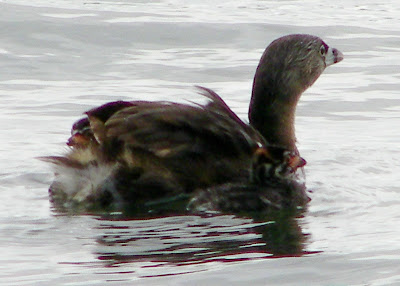
It turned out the parent had two small passengers. And they're staying close by.

I found the other adult diving among the lily pads a bit farther south. No passengers there.
Previous posts:
June 3: one egg.
June 10: seven eggs.
June 27:first hatching.
June 28: second hatching.
June 30: three babies, two eggs
July 1: still three babies, two eggs
July 3: three babies, one egg

Hmm. This bird is riding pretty high in the water. And where's that peeping sound coming from? Wait. Those back feathers are wiggling.

It turned out the parent had two small passengers. And they're staying close by.

I found the other adult diving among the lily pads a bit farther south. No passengers there.
Previous posts:
June 3: one egg.
June 10: seven eggs.
June 27:first hatching.
June 28: second hatching.
June 30: three babies, two eggs
July 1: still three babies, two eggs
July 3: three babies, one egg

Friday, July 3, 2009
Green lake grebes eating feathers
As of 10 a.m. today, there were three babies and one egg in the pied-billed grebe nest. Here the adults are singing a duet, while the babies swim toward them.

Martin Muller emailed me with this fascinating point about the feather seen on the baby's bill in Wednesday's pictures. He wrote that grebes eat their own feathers, and that their flank feathers molt constantly, giving them a steady supply.
"All grebes will eat their own feathers as well as some 'found feathers' (for instance when ducks are molting and many small feathers are floating around). Sometimes the very first 'meal' a newly hatched grebe chick receives is a feather the adult provides.
Feathers line the inside of grebe stomachs and also provide a 'plug' in the pyloric exit (stomach to small intestines). The feathers are thought to provide protection from sharp fish bones (adult grebes swallow fish whole and they slowly dissolve in the stomach acid, youngsters are proffered smaller pieces of fish but those may contain fish bones too), as well as a 'strainer' to keep the partially digested food inside the stomach long enough to dissolve.
A third theory postulates that the feathers provide bulk for pellets (grebes regurgitate pellets containing indigestible matter like chitin shields of insects they eat, or plant material ingested along with animal mater). The pellet is also thought to clean the esophagus of parasites as it works its way up and out (like the sponge that is sent through pipes, using water pressure, to clean the inside of the pipes at dairy farms, hence the name for the theory 'polishing sponge theory' -translated from the original Dutch 'poetsprop theory'-)."
Here's an adult feeding a youngster a feather.

Previous posts:
June 3: one egg.
June 10: seven eggs.
June 27:first hatching.
June 28: second hatching.
June 30: three babies, two eggs
July 1: still three babies, two eggs

Martin Muller emailed me with this fascinating point about the feather seen on the baby's bill in Wednesday's pictures. He wrote that grebes eat their own feathers, and that their flank feathers molt constantly, giving them a steady supply.
"All grebes will eat their own feathers as well as some 'found feathers' (for instance when ducks are molting and many small feathers are floating around). Sometimes the very first 'meal' a newly hatched grebe chick receives is a feather the adult provides.
Feathers line the inside of grebe stomachs and also provide a 'plug' in the pyloric exit (stomach to small intestines). The feathers are thought to provide protection from sharp fish bones (adult grebes swallow fish whole and they slowly dissolve in the stomach acid, youngsters are proffered smaller pieces of fish but those may contain fish bones too), as well as a 'strainer' to keep the partially digested food inside the stomach long enough to dissolve.
A third theory postulates that the feathers provide bulk for pellets (grebes regurgitate pellets containing indigestible matter like chitin shields of insects they eat, or plant material ingested along with animal mater). The pellet is also thought to clean the esophagus of parasites as it works its way up and out (like the sponge that is sent through pipes, using water pressure, to clean the inside of the pipes at dairy farms, hence the name for the theory 'polishing sponge theory' -translated from the original Dutch 'poetsprop theory'-)."
Here's an adult feeding a youngster a feather.

Previous posts:
June 3: one egg.
June 10: seven eggs.
June 27:first hatching.
June 28: second hatching.
June 30: three babies, two eggs
July 1: still three babies, two eggs
Subscribe to:
Posts (Atom)