Tuesday, May 12, 2009
How to keep birds away from jets
I wrote an article in today's Seattle Post-Intelligencer, about Steve Osmek, Sea-Tac Airport's wildlife biologist.

Monday, May 11, 2009
Bird electrocutions on Vancouver Island

The Victoria Times-Colonist reports on a problem that is one of the leading ways humans accidentally kill birds. The U.S. Fish and Wildlife Service estimates that electrical transmission lines kill as many as 174 million U.S. birds a year, which is deaths than vehicle collisions cause.
Photo from the U.S. Fish and Wildlife Service.
You, with the cloven hooves and the big brown eyes!
Get off the road!

Mule Deer cross U.S. Highway 97 south of Bend, Ore. twice each year: in the spring when they go from the High Desert to the Cascade Foothills, and in the fall when they go back. Each year, about 95 of them die on the road.
The Oregon Department of Transportation is adding two wildlife crossings as part of revamping a four-mile stretch of the highway says this Associated Press report, which includes the details of how wildlife biologists plan to coax the deer into the tunnels.
Photo from the National Park Service
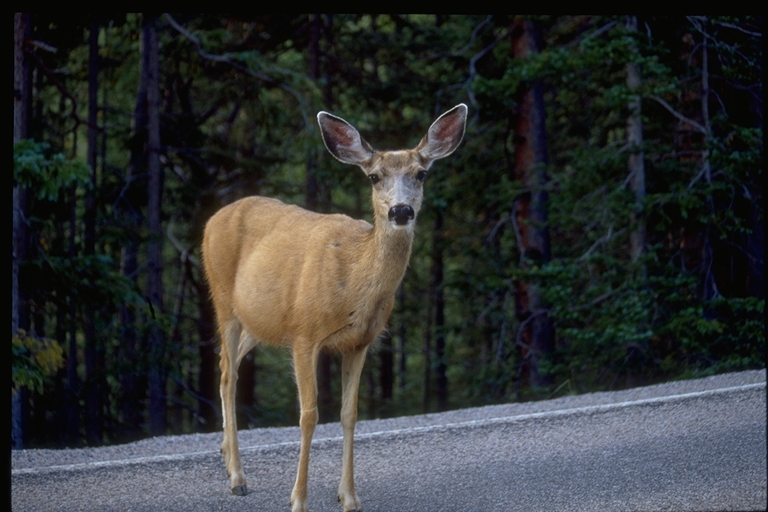
Mule Deer cross U.S. Highway 97 south of Bend, Ore. twice each year: in the spring when they go from the High Desert to the Cascade Foothills, and in the fall when they go back. Each year, about 95 of them die on the road.
The Oregon Department of Transportation is adding two wildlife crossings as part of revamping a four-mile stretch of the highway says this Associated Press report, which includes the details of how wildlife biologists plan to coax the deer into the tunnels.
Photo from the National Park Service
The lonesome abalone
The Seattle Times has an article on the plight of the northern abalone. The heavily poached sea-snail has reached such low densities, that the remaining ones have trouble getting close enough to each other to ensure that when their eggs and sperm can meet in the water column.
Friday, May 8, 2009
Rare fen protected in Willamette Valley
The Oregonian has an article about Peach Cove Fen, a floating mat of peat moss and rare plants now protected by the Portland Metropolitan area.
Via Sightline Daily.
Via Sightline Daily.
Thursday, May 7, 2009
Pika closer to endangered species listing
The Associated Press reports that the U.S. Fish and Wildlife will review the status of the American pika and announce its findings by next February. If it is found to be threatened, it will be the first animal in the lower 48 states to be listed because of the warming climate.
For more details, see my earlier post.

National Park Service photo.
For more details, see my earlier post.

National Park Service photo.
Subscribe to:
Posts (Atom)