
Sunday, May 1, 2016
Little Blue Bee
I found several of these roving on California poppies in my yard. Some kind of sweat bee?


Monday, April 25, 2016
Rounding a curve in a trail in Magnuson Park, I noticed a pair of withered willow leaves that seemed strangely symmetrical. On closer inspection, they weren't leaves at all.
 They were the wings of a sphinx moth. A biiig sphinx moth.
 That's my not-especially-big thumb. I figure the fore-wing of this beastie measures five centimeters. Looks to me like a Smerinthus opthalmica, a lumbering nocturnal moth whose caterpillars feed on willow and cottonwood. The adults don't feed on anything. They don't have the mouth parts. They are just around to make caterpillars.
S. opthalmica aren't the only monster moths haunting our nights hereabouts. There are other sphinx moths, and giant silkworm moths including the gloriously named Polyphemus.
Here's another angle on the creature.


S. opthalmica aren't the only monster moths haunting our nights hereabouts. There are other sphinx moths, and giant silkworm moths including the gloriously named Polyphemus.
Here's another angle on the creature.

Saturday, February 27, 2016
Four hummingbirds in a pink tree

Then the adult male started chirping and doing loop-de-loop territorial displays, right over the tree. This did not appear to have any effect on the three other hummingbirds peacefully guzzling nectar, and after a while he stopped, drank some nectar from the flowers, and then flew to a nearby tree, where he let off volleys of chirps - what I call the squeaky bicycle noise. And the others kept eating.
Monday, February 15, 2016
Raindrops on Pussy Willows
The soggy marshy bits of Magnuson Park make an odd kind of wetland. To be precise, it's a wetland themed garden, constructed, dredged and planted to approximate what the area around the park was like before 1916, when the U.S. Army Corps of Engineers finished the Ship Canal, and lowered the level of Lake Washington by about nine feet. There are of course important differences between this and a natural wetland: crushed limestone trails, metal bridges, and above all, drains, so that the water doesn't inconvenience its human visitors too much.
The result is joyously birdy. Starting at the end of January, red-winged blackbirds start calling. Ducks, coots and pied-billed grebes forage around the ponds. And this weekend, the willows are blooming.

The result is joyously birdy. Starting at the end of January, red-winged blackbirds start calling. Ducks, coots and pied-billed grebes forage around the ponds. And this weekend, the willows are blooming.

Thursday, August 13, 2015
Where the slugs roam

Taken on July 26 on Salt Spring Island, during a rare, wet interlude in this summer's drought.
Monday, April 8, 2013
Satyr comma, Oak Bay Native Plant Garden
Out for a stroll between rainstorms this weekend, I came across this beautiful fellow catching some sun on a patch of yellow marsh-marigold. It's a satyr comma. I don't know how this insect is anything like the man-goat hybrids that cavorted around the god Pan, but the comma name is for the white mark on his lower underwings.
 This species hibernates as adults, emerging on warm days. I suppose that a good chunk of Saturday in Victoria qualified as a warm day. There were two of them in the Oak Bay Native Plant garden. I think they were both males. One reason I think this is that both had the same bright coloring. The other is that in between spells of basking in patches of sunlight, they would fly at each other, in a flurry of wing-beats, sometimes touching. It was probably quite a savage scene from a butterfly's perspective.
 It's a satyr comma. I don't know how this insect is anything like the man-goat hybrids that cavorted around the god Pan, but the comma name is for the white mark on his lower underwings.
 This species hibernates as adults, emerging on warm days. I suppose that a good chunk of Saturday in Victoria qualified as a warm day. There were two of them in the Oak Bay Native Plant garden. I think they were both males. One reason I think this is that both had the same bright coloring. The other is that in between spells of basking in patches of sunlight, they would fly at each other, in a flurry of wing-beats, sometimes touching. It was probably quite a savage scene from a butterfly's perspective.
Tuesday, March 26, 2013
No dragonflies
Yesterday, I spent a sunny half-hour sitting by a nice little pond.
The things I do for science.
My reason for being there is the Dragonfly Pond Watch Project, a citizen science project aiming to record the movements of five different dragonfly species: common green darner, black saddlebags , wandering glider (the most widespread dragonfly on the planet, according to Wikipedia), spot-winged glider, and variegated meadowhawk.
I like the idea of these creatures zooming hundreds of miles on their shiny wings, and I would love to see some of them on their journey. Yesterday was an unlikely day for it, because the earliest any of them are expected to show up is April.
I did see yellow-rumped warblers, chickadees, robins, and two tree-loads of pine siskins. A male red-winged blackbird let off a volley of sound from a bush next to me, as a female picked through the branches. A ruby-crowned kinglet ventured within arms length. Two song sparrows sang at each other, a flicker let off a hicupping tirade and a male rufous hummingbird zipped by, making that mechanical chirp that always reminds me of a 1980s sci-fi space laser. A male Anna's Hummingbird did diving displays over the pond. When he went off, a female quietly came in and gathered fluff from the top of some of the cat-tails.
No dragonflies, though.


Tuesday, March 12, 2013
Making noise, Mountlake Fill
The first thing that hit me when I opened the car door was the sound of red-winged blackbirds, male ones, perched on trees, bushes and cat-tails, flashing their red epaulettes and declaring their territorial dominance and their availability to mate. 
 Another sign of spring: tree swallows and violet-green swallows, newly arrived and chittering and swooping around. Sometimes a male would feed a female in mid-flight.


 Another sign of spring: tree swallows and violet-green swallows, newly arrived and chittering and swooping around. Sometimes a male would feed a female in mid-flight.

Tuesday, February 26, 2013
Back yard visitors
A pair of western scrub-jays hang out in our yard. We call them Mr. and Mrs. Boink. They appear have caches of hazelnuts from our trees. They enjoy our seed feeders and the flooded flowerpot that serves as a bird bath, and in the past few weeks they've spent an awful lot of time darting in and out of a thick hedge in our yard. We hope that means that they are setting up to have baby Boinks.
Here's a picture of Mrs. (or Mr.) Boink: Other birds come and go, chiefly black-capped chickadees and juncos. There's a flicker or a towhee from time to time, white-crowned and golden-crowned sparrows, Anna's hummingbirds, robins and roving flocks of bushtits or house sparrows.
Today the Boinks had new visitors: a pair of Steller's jays.
 That got the scrub jays' attention.


 For a few minutes the two sets of jays hopped around each other. The Steller's Jays looked very fluffy of feather, as if they were trying to seem big.
Eventually the scrub-jays started flying at the Steller's Jays. Three or four skirmishes, and the Steller's Jays flew across the street. One of the Boinks sat on the power line yelling after them.
Later on, the chitter of a flock of chickadees and juncos turned to alarm calls, and found another new bird sitting on my fence.
 It's a young sharp-shinned hawk, a predator of small birds. The boinks weren't around when it settled on the fence, and it didn't stay long. I wonder if I'll see it again.
 Other birds come and go, chiefly black-capped chickadees and juncos. There's a flicker or a towhee from time to time, white-crowned and golden-crowned sparrows, Anna's hummingbirds, robins and roving flocks of bushtits or house sparrows.
Today the Boinks had new visitors: a pair of Steller's jays.
 That got the scrub jays' attention.


 For a few minutes the two sets of jays hopped around each other. The Steller's Jays looked very fluffy of feather, as if they were trying to seem big.
Eventually the scrub-jays started flying at the Steller's Jays. Three or four skirmishes, and the Steller's Jays flew across the street. One of the Boinks sat on the power line yelling after them.
Later on, the chitter of a flock of chickadees and juncos turned to alarm calls, and found another new bird sitting on my fence.
 It's a young sharp-shinned hawk, a predator of small birds. The boinks weren't around when it settled on the fence, and it didn't stay long. I wonder if I'll see it again.
Thursday, February 21, 2013
Carkeek Park, February
Tucked in the upper reaches of Carkeek Park is an old orchard, planted by homesteaders in 1890 or so. For the past thirty years or so, volunteers, including the Friends of Piper's Orchard have been tending it and planting more trees. About 15 of the original plantings remain, ancient breeds such as Wealthy, Red Astrachan,Gravenstein and Guyot Pear.
I watched a flock of about 70 pine siskins flutter around the orchard and then settle on a big tree at the back (a Rhode Island Greening, if I'm reading the map correctly). It is a magnificent tree. Really, I should have lingered and taken a good portrait of it. But instead I took bad pictures of the birds...
 ...who promptly flew away.
 Pine siskins spend their winters roaming around in flocks. Where they go depends on the supply of seeds. They seldom winter in the same area two years in a row. This year, they favored our region, and showed up on in record numbers on the Christmas Bird Counts. They're fun to watch.
In his "Essential Field Guide Companion," Pete Dunne describes the pine siskin as "a quick, nervous, dark, drab, ultra-streaky pipsqueak of a bird that makes up in sass and belligerence what it lacks in size." Pete Dunne is fun to read.
Moving along a trail, a willow which fell down over the winter is still alive.
 But then, it is hard to kill a willow. These are trees that evolved to coexist with beavers, ruthlessly efficient tree downers, who happen to find willow cambium delicious. But then there are plants that are tougher, such as the ivy still growing up the willow's trunk.

Tuesday, February 12, 2013
Not really raining, Montlake Fill
This morning we had the kind of precipitation that Seattlites often call "not really raining." The expression applies to two distinct types of weather. One is a slow drizzle. The other is a light mist with drops so tiny that they don't fall to the ground but waft with the air currents and pool on the surface of your skin. It's not really raining, but more like a cloud coming to ground.
It's not fog - you can see things, sort of. Here's the 520 bridge.
 In fact, the not-really rain illuminates things that we overlook on clear days, such as the tiny webs of spiders, still active in February.


Wednesday, February 6, 2013
Winter Walk, Discovery Park
When you first enter the woods, there's a feeling of hush. Even the colors are quiet.
 Then the details pop out. The underbrush is full of song sparrows. Most of them are giving simple chirps, but every so often one of them lets loose a barrage of notes and chuckles. Breeding season is coming.
 At the pond, yellow-rumped warblers, flutter from willow to willow, peck and squeak. Their nickname is one of my favorite pieces of birder slang: butterbutts.
 On the north beach a group of lesser scaup rest and preen.
 When a dog appears on the trail, they take to the water.
 But then a pair of sea lions swim by...
 ...so they head back to the beach.
 The bluff has some fresh landslide scars.
 Buds are bursting on the Indian Plum.
 A pileated woodpecker methodically rips up a log, plucking out fat pearly grubs.
 What a beauty.


Monday, August 15, 2011
Bonaparte's gulls, Cortes Island

With their graceful white wings and jay-like raspy call, Bonaparte's gulls are a glorious part of the B.C. coast summer scenery, though I don't think I see them as often as I used to on Saltspring Island. Go to the Discovery Islands or Denman and Hornby and they're still there, floating over the wide, calm waters of the Strait of Georgia.
Much as they're part of summer, they're also harbingers of summer's ends. By the beginning of August, almost all of them have lost the black heads of their breeding plumage and are wearing wintry white.
Big and small, Hannegan Pass Trail
Yesterday, family explored Hannegan Pass Trail, in Mount Baker-Snoqualmie National Forest. We made it three miles out and back. My seven-year-old daughter was amazed by the scale of her surroundings.

"We're so little," she said.
Little we may be, but we're enormous compared to some.

It looks like a wasp, but I couldn't say what kind. The flower is a Columbia lily.
Tuesday, May 24, 2011
Cinnamon teal, Montlake Fill
Isn't he handsome?

I would gawk at that red eye, those chestnut feathers and china blue shoulder patches, even if cinnamon teal were animals I saw all the time.
As it is, it's all new. A life bird, in fact. When I watched a pair of them fly around me, and then came across this drake, that was my first time noticing this species.
I am not a "lister" -- though I do track what I see when I'm traveling -- but I do get a satisfaction out of witnessing a species new to me.
It's an allure that makes birders biased observers of nature. We're great at spotting whatever storm-tossed oddities show up in our area, but we can be oblivious to huge population shifts in common birds.
And common birds do have their pleasures, though they might not be as easily summarized in the phrase "life bird." There's the way a gaudy bird, such as a common yellowthroat, can vanish into a shrub. There's the sputterings of a marsh wren, a bird given to extended diatribes of squeaks, rattles, buzzes and notes - part bird, part machine, all bad-ass. There's the constant rivalry of red-winged blackbirds, with the males calling from cattails and shrubs, and the females discreetly jockeying for position below. This time of year, the males are ready to attack all comers, other males, crows, and eagles.
So I'd have had a nice time birding, even if I hadn't seen the cinnamon teal. But I'm glad I did.
Seen in Discovery Park, May 17
When I pointed this Hooker's willow out to my Dad, he asked me which famous 19th century naturalist it was named after: Sir William Jackson Hooker, the first official director of Kew Gardens or his son Sir Joseph Dalton Hooker, the second director of Kew Gardens. It was an amazingly trivial question, so of course I Googled the answer. It's William.

I believe this is Pacific willow.

And this is youth-on-age.

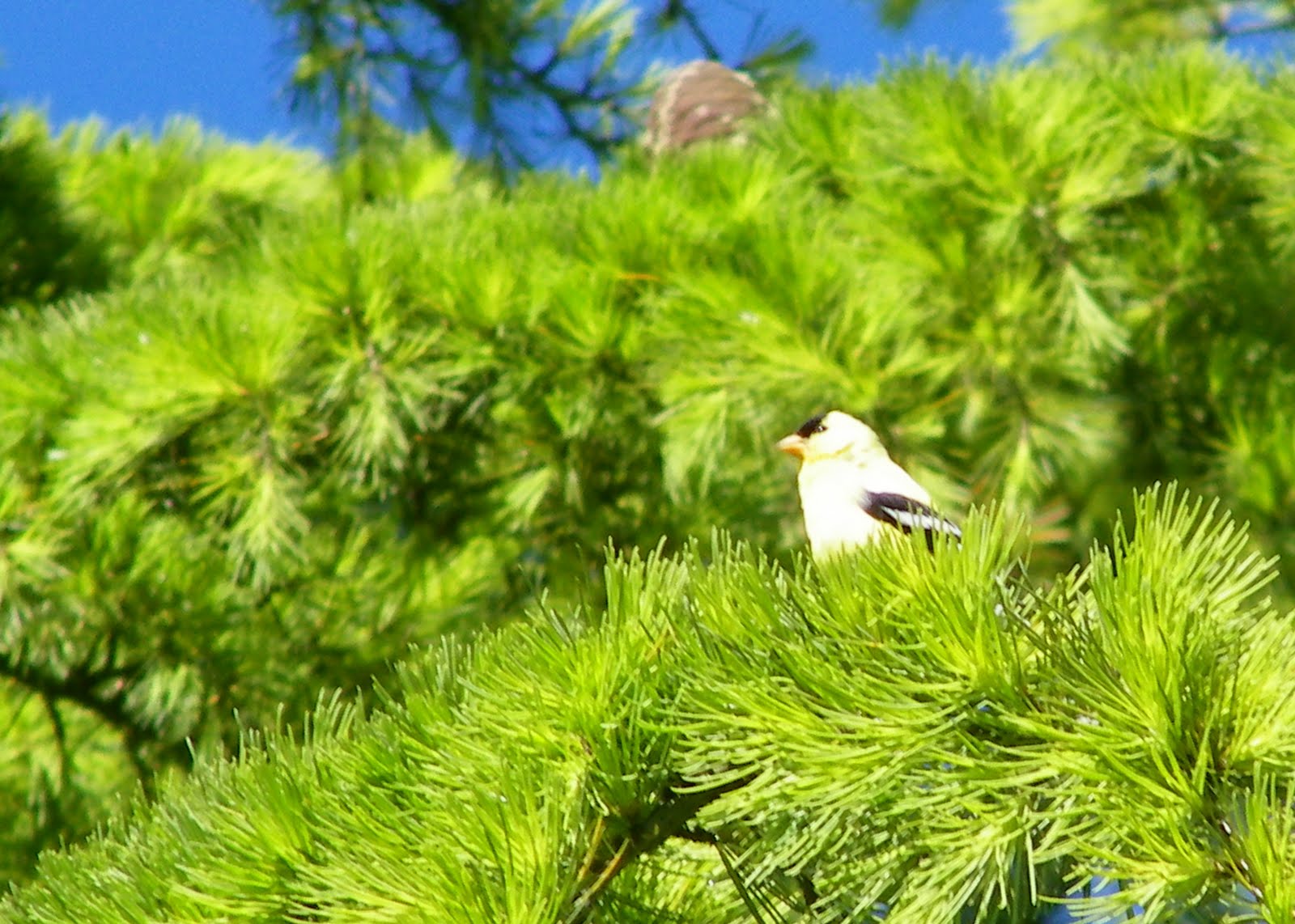
Bright yellow goldfinch, dark green pine.

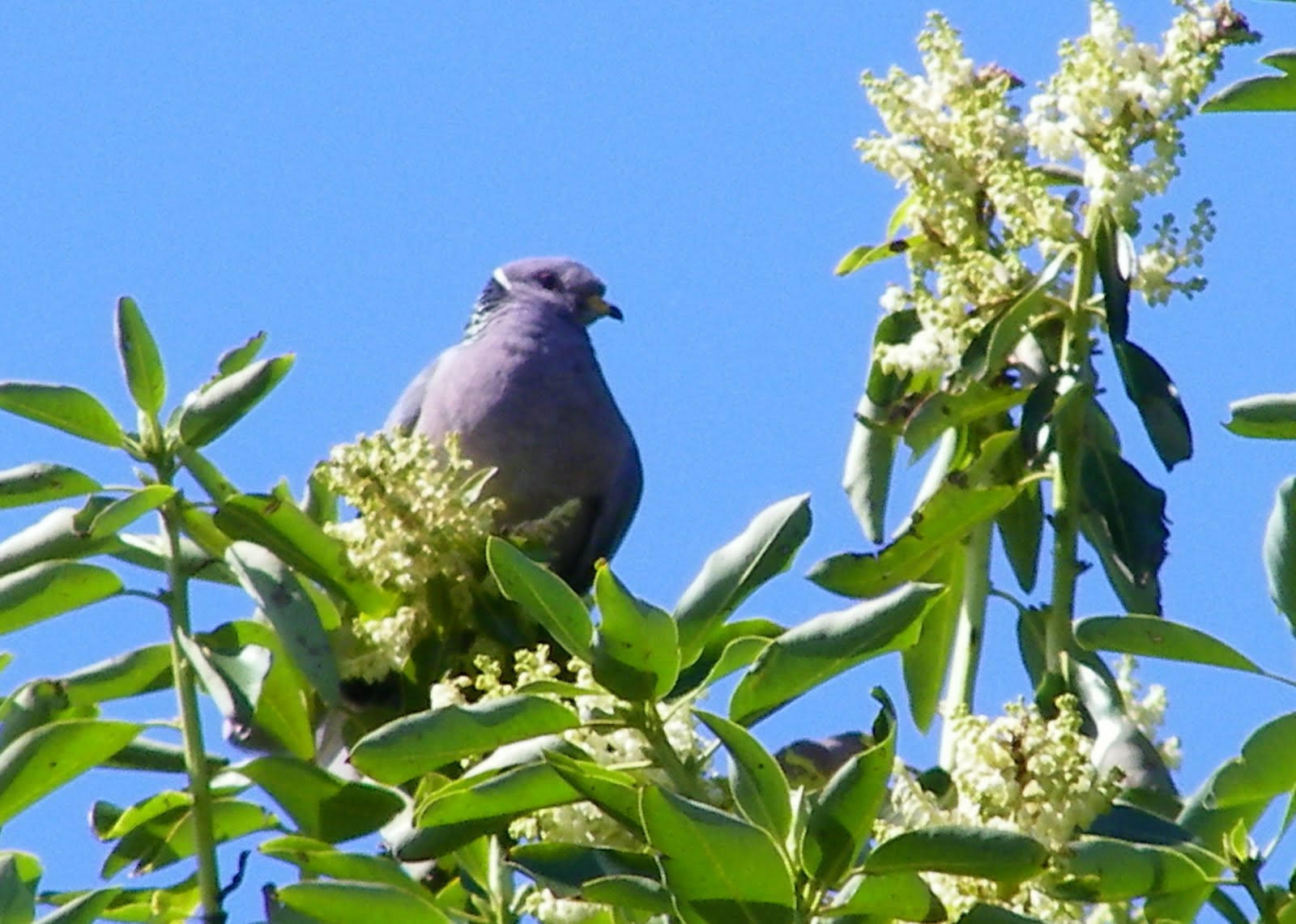
Band-tailed pigeon on madrona.


I believe this is Pacific willow.

And this is youth-on-age.

Bright yellow goldfinch, dark green pine.
Band-tailed pigeon on madrona.
Tuesday, January 11, 2011
Varied Thrush, Discovery Park
The woods at Discovery Park were quiet this morning. With temperatures near freezing and snow on the way, few birds were interested in loud dissertations on territory or romance. They were too busy eating. Those in groups had a chirp here and there, and one pileated woopecker let out a long cackle but most birds were quiet. The best way to see one was to watch for movement.
Still, the cold weather brought some beautiful visitors.

Varied thrushes are a species most birders are a little silly about. Their plumage is beautiful, with the blue-gray back and the bold orange stripes. Their call is haunting, and their habits mean that it's a treat to see one.
They prefer old forests, and generally only come to town when harsh weather pushes them out of the high country. They also delight in foiling all my attempts to photograph them. They tend to bounce out of the way whenever I aim my camera, and when I look up to reposition it, it often takes me a while to find them -- those orange stripes have an amazing way of blending in. So, I'm happy to have one in focus. Almost, anyway.

Tuesday, January 4, 2011
Goose neck barnacles
There's a beach we like to go to that has a rocky outcrop pointing toward Trial Island. The deeper crevices in the rocks are full of goose neck barnacles.

They are attached to the rock by a leathery neck, so they can bend with the waves, as they gather plankton.

The waves carried them here, in the form of larvae that cemented themselves to the rock. And after they mate in the spring the waves will take their larvae away.


They are attached to the rock by a leathery neck, so they can bend with the waves, as they gather plankton.

The waves carried them here, in the form of larvae that cemented themselves to the rock. And after they mate in the spring the waves will take their larvae away.

Subscribe to:
Posts (Atom)